Query To give Dba Object for specific User

Simple Topic let you know what is the database object for specific user

SELECT object_name, object_type
FROM   all_objects
WHERE  owner = 'SYS'
AND    object_type IN ('PACKAGE', 'PACKAGE BODY')
ORDER BY object_name, object_type;

Thank you
Osama Mustafa

Dataguard on Different Operating Systems

In 10g, dataguard started to support different binaries on primary and standby database servers with the same OS family.

  For example :

Microsoft Windows 64-bit on primary and Microsoft Windows 32-bit
Microsoft Windows 64-bit for AMD on standby database server.

However with 11g, dataguard also supports different OS on primary and standby servers. I wanted to share the support matrix for this feature.

 Check this Blog which is talking about this topics and post some Notes From My Oracle Support :

Emre Baransel.


Thank you
Osama Mustafa

Copy Command in Sqlplus

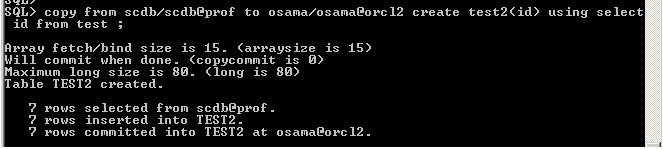
Today as any Database administrator i wake up on new task , they want import some tables from Developer environment to Production , So I used Copy Command .

its usual used for copy tables from database to Another  , but you have to know this way is very useful specially if you have long Data type in your tables , i will explain it , and Define Two Database in your TNS.

create table osama as select * from long_table ;

You will Get this error :

ERROR at line 1:

ORA-00997: illegal use of LONG datatype

copy from user1/password@orcl  to user2/password@orcl2 create

using ;

The Output :

Array fetch/bind size is 30. (arraysize is 30)
Will commit when done. (copycommit is 0)
Maximum long size is 40. (long is 40)

Table osama created.

Simple !!!

Useful Link : 
1-Oracle Document .
2-Examples. 

Thank you 
Osama Mustafa 

Oracle Databases from 11.2.0.1 to 11.2.0.2

Basic Steps : 

1. Install 11.2.0.2 into a separate ORACLE_HOME.
2. Take a full backup of the database.
3. Always shutdown the database cleanly

After Installing 11.2.0.2 , Go to 11.2.0.1 database and run :

Connect as sys
SQL> spool pre_upgrade.log
SQL> @ORACLE_HOME/rdbms/admin/utlu112i.sql
SQL> spool off 

 To check Data Dictionary 

Connect as sys
SQL> EXECUTE dbms_stats.gather_dictionary_stats;
Note: Ignore if dbms_stats.gather_dictionary_stats was run once.

To Fix invalid Object in the database :

connect as sys
SQL> @$ORACLE_HOME/rdbms/admin/utlrp.sql

Run pre-upgrade diagnostic utility dbupgradiag.sql

$ cd $ORACLE_HOME/rdbms/admin
$ sqlplus “/ as sysdba”
SQL> spool pre_dbupgdiag.log
SQL>@dbupgdiag.sql
SQL>spool off 

 if the dbupgdiag.sql script reports any invalid objects, run $ORACLE_HOME/rdbms/admin/utlrp.sql 

Configure the 11.2.0.1 database environment for 11.2.0.2 Upgrade 

Copy the following Files to New Home 11.2.0.2 :

  1. Spfile/Pfile/init.ora
  2. orapwd
  3. tnsname.ora
  4. Listener.ora
  5. OC4J Home (ORACLE_HOME/oc4j/j2ee/OC4J_DBConsole_) Only if you have enterprise manager

Set The environment to 11.2.0.2

export ORACLE_HOME=/u01/app/oracle/prouct/11.2.0.2
export ORACLE_SID=ORCL

Note : Replace the Path , LD_Library_Path to new Home .

Upgrade 11.2.0.1 database to 11.2.0.2

sqlplus  / as sysdba
 spool upgrade.log
startup upgrade
set echo on
@?/rdbms/admin/catupgrd.sql;
spool off
shutdown immediate

Restart the database in normal mode

sqlplus  / as sysdba
 @/opt/app/oracle/product/11.2.0.2/rdbms/admin/catuppst.sql;
@/opt/app/oracle/product/11.2.0.2/rdbms/admin/utlrp.sql;
select comp_name,version,status from dba_registry;
select owner,count(*) from dba_objects where status != ‘VALID’ group by owner;

Change the compatibility parameter

Change the compatible parameter and restart the database.

SQL> alter system set compatible=’11.2.0.2.0′ scope=spfile;
SQL> shutdown immediate;
SQL> startup;

And Please Make Sure the listener has been started from the new home not the old one .

I will Post Upgrade to 11.2.0.3 “Enshalla”

Thank you
Osama Mustafa
ORA-02021: DDL operations are not allowed on a remote database

*Cause: An attempt was made to use a DDL operation on a remote database.
 For example, “CREATE TABLE tablename@remotedbname …”.
*Action: To alter the remote database structure, you must connect to the
remote database with the appropriate privileges.

But you can avoide this  Using :

exec dbms_utility.exec_ddl_statement@db_link(‘your statment’);


Thank you
Osama Mustafa

Instance Caging

Instance Caging

Sometimes When you are doing some testing on one machine and have more than one instance with limited hardware resource , Oracle let control that resource by caging its new feature in 11g its method to cage or bound the instance to use a certain number of cpu instead to take all available CPU simple way :

Alter system set CPU_Count = 2 

Just as note this method work with Resource Manager so you need to enable it , and create resource manager plan first before doing Instance Caging .

Instance Caging Benefits :

  1. Useful when you are using multiple instance .
  2. Allowing CPU , Resource allocation be done effectively .
  3. Control CPU Consumption of each Instance .

Thank you
Osama Mustafa

dim-00014

While You are trying to install Oracle Database On Windows 2008 R2 or any other Microsoft Os with user not administrator you will get

DIM-00014: Cannot open the Windows NT Service Control Manager.
O/S-Error: (OS 5) Access is denied.
 
Solution :

Run DBCA as administrator .

Click on start button -> All programs -> Accessories -> right click the command prompt icon > choose run as administrator -> 
invoke dbca in the commandline or oradim can also be used.
 
Thank you 
Osama mustafa 

ORA-00322 ORA-00312

The Above error Appear In My Alert Log , I have Single Test DB , Sometimes the same error appear In Standby Database you don’t follow the same Produce , i didn’t find any document related to this error for single database so hope this will be useful 

  ORA-00322: log 3 of thread 1 is not current copy
ORA-00312: online log 3 thread 1 :
‘/u01/app/oracle/flash_recovery_area/ORCL/onlinelog/o1_mf_3_79fz3gx8_.log’
ORA-00322: log 3 of thread 1 is not current copy
ORA-00312: online log 3 thread 1 :
‘/u01/app/oracle/oradata/ORCL/onlinelog/o1_mf_3_79fz3g1v_.log’

Solution

Step-One :
conn / as sysdba

shutdown immediate ;

startup mount ;

Step-Two :
Recover database using backup controlfile;
 Note :
Provide path where your redo log file locate , in My case “/u01/app/oracle/oradata/ORCL/”

Step-three:
alter database open resetlogs;
shutdown immediate;
startup;

Thank you
Osama Mustafa