manual record to the Alert.log

Oracle Give us an Option to record our own error in alertlog.log But How can we Do that :

The procedure kdswrt in dbms_system package allows us to write own messages in the alert log / trace files or both.It receives two parameters:

  1. –   A number that indicates where do we want to write our message:

  •      Writing to a TRACE file.
  •      Writing to the Alert.log file.
  •      Writing to both of them.

       2.   A text string (the message itself).

How to Use it  :

exec dbms_system.ksdwrt(2, ‘ORA-10200: Error in Database.);

 Sun Sep 29 10:00:57 2010
Thread 1 advanced to log sequence 7615 (LGWR switch)
Current log# 1 seq# 7615 mem# 0: u01/app/oracle/product/11.2.0/dbhome_1/REDO01.LOG
Sun Sep 29 11:10:15 2010
ORA-10200: Error in Database.
Sun Sep 29 11:10:15 2010
Thread 1 advanced to log sequence 7616 (LGWR switch)
Current log# 2 seq# 7616 mem# 0: u01/app/oracle/product/11.2.0/dbhome_1/REDO02.LOG
Sun Sep 29 10:00:57 2010
Thread 1 advanced to log sequence 7615 (LGWR switch)
Current log# 1 seq# 7615 mem# 0: u01/app/oracle/product/11.2.0/dbhome_1/REDO01.LOG

 It is a very useful feature, as we can use it in our PL/SQL procedures inside the exception handling section or to indicate the procedure’s progression.

As i mention before my blog you can use X$DBGALERTEXT to check alert log via sqlplus (11g).

Thank you
Osama Mustafa
Check Rman Backup/Validate

There’s More than One Way to Do it :

Check One :

To check Datavase Backup

RMAN > Restore Validate Database ;

Check Two : 

Check Spfile

RMAN > restore validate spfile to ‘c:\temp\spfile.ora’;

Check Three :

Test Control File

RMAN> restore validate controlfile to ‘c:\temp\control01.ctl’;

Check Four :

Test Archive log

RMAN> list backup of archivelog all;

 or

RMAN> list backup of archivelog all completed after ‘sysdate -1’;

Then

RMAN> restore validate archivelog from sequence XXX until sequence XXX; 

Thank you
Osama Mustafa

12c new features

Tom Kyte , Talk about 12c new features LETS START :

1) “With” clause can define PL/SQL functions

2) Improved defaults, including Default col to a sequence or “default if (on) null”.  Or always use a generated as an identity (with optional sequence def info).  Or Metadata-only defaults (default on an added column). 

3) Bigger varchar2, nvarchar2, raw -up to 32K.  But follows rules like LOB, if over 4K will be out of line. (max_SQL_String_Size init param)

4) TopN and Pagenation queries using the ‘OFFSET’ clause + optional ‘FETCH next N rows’ in SELECT.  Eg: SELECT … FROM t ORDER BY y FETCH FIRST 5 ROWS

5) Row pattern matching using the “MATCH_RECOGNIZE” clause.  Gonna take a while to get this one.

6) Partitioning improvements including ASYNC Global Index maintenance (includes new jobs to do work ‘later’), cascade truncate & exchange, multi ops in a single DDL, online partition moves (no RDBMS_REDEFINITION), “interval + reference” partitioning.

7) Adaptive execution plans, which sets thresholds and allows execution plans to switch if threshold is exceeded.  (Also ‘gather_plan_statistics’ hint.)  Shown by ‘Statistics Collector’ steps in trace/tkprof.

8) Enhanced statistics. Dynamic sampling goes to ‘eleven’, turning it persistent.  New histograms: hybrid (for more than 254 distinct values, instead of height-balanced) and top.  Stats gathered on data loads automatically. (By the way, don’t regather stats if not needed.)  Session private statistics for GTTs. 

9) UNDO for temporary objects, managed in TEMP, which eliminates REDO on the permanent UNDO. (ALTER SESSION/SYSTEM SET TEMP_UNDO_ENABLED=TRUE/FALSE)

10) Data optimization, or Information Lifecycle Management, which detects block use – hot, medium, dormant – and allows policies in table defintion (new ILM clause) to compress or archive data after time.

11) “transaction Guard’ to preserve commit state, which includes TAF r/w transfer and restart for some types of transactions.

12) pluggable databases!  Implications too numerous to list right now.  Suffice it to say, huge resource improvements, huge consolidation possibilities.  Looking forward to reality.

Thank you
Osama mustafa

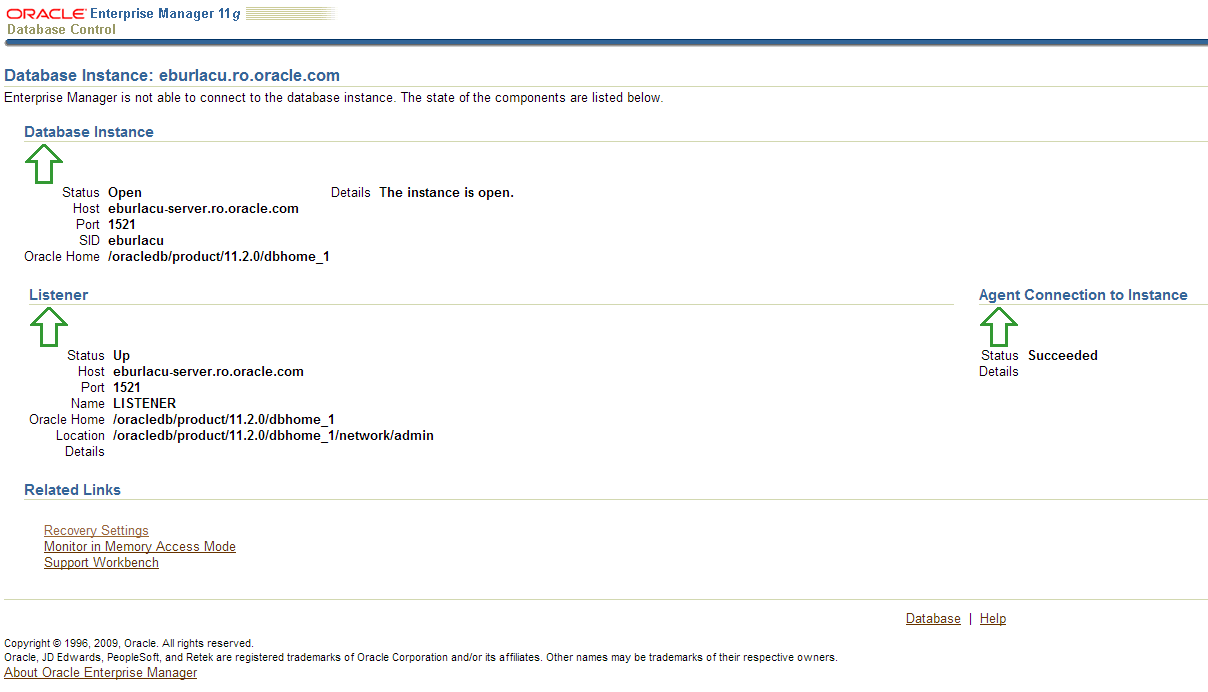
emagent : Memory 0x0 encountered

When you try to login to EM the following screen appear :

-bash-3.00$ emctl stop dbconsole
Oracle Enterprise Manager 11g Database Control Release 11.1.0.7.0
Copyright (c) 1996, 2008 Oracle Corporation. All rights reserved.

https://rgpdb1.rg.com:1158/em/console/aboutApplication

Stopping Oracle Enterprise Manager 11g Database Control ...
... Stopped.
-bash-3.00$
-bash-3.00$
-bash-3.00$
-bash-3.00$ emctl start dbconsole
Oracle Enterprise Manager 11g Database Control Release 11.1.0.7.0
Copyright (c) 1996, 2008 Oracle Corporation. All rights reserved.

https://rgpdb1.rg.com:1158/em/console/aboutApplication

Starting Oracle Enterprise Manager 11g Database Control ............................................................................................. failed.
------------------------------------------------------------------
Logs are generated in directory /pdb01/oraprod/db/tech_st/11.1.0/rgpdb1_rgprd1/sysman/log
 
 
Solution:

Check the following processes and kill them :

ps -ef | grep emagent
ps -ef | grep DEMS

-bash-3.00$ kill -9 PID

 Then

-bash-3.00$ emctl stop dbconsole
-bash-3.00$ emctl start dbconsole 

 
 Thank you 
Osama Mustafa 


Oracle RAC 12c: New Features

1. Application Continuity

2. Oracle Flex ASM
With this feature, database instances use remote ASM instances. 


3. Oracle ASM Disk Scrubbing

Checks for logical data corruptions and repair them automatically.


4. Enhancements to Policy-based Databases

Actively utilizes different sized servers


5. What – if analysis for server pool management


6. Standardized deployment and patching 

Introducing GHS, rapid home provisioning and gold images


7. A new “ghctl” command for better patching


8. Oracle Utility Cluster


9. Dynamic IP Management and name resolution made easy


10. IPv6 Based IP Addresses Support for client connectivity


11. Multi-purpose Installation


12. Oracle installer will run Fix-up scripts & “root.sh” scripts across nodes. You don’t have to run the scripts manually on RAC nodes.

Thank you Asif Momen .

Thank you 
Osama Mustafa 

ORA-02020: too many database links in use

Error :

ORA-02020: too many database links in use

Solution :

Increase the open_links and open_links_instance parameter in the DB . Bounce Database

Or

SQL>alter session close database link “link name”;

Thank you
Osama mustafa

ORA-19527: physical standby redo log must be renamed

In Standby Database Alert log i Found the following :

Attempt to start background Managed Standby Recovery process (neonprd)
MRP0 started with pid=31, OS id=5623962
Mon Oct 8 09:12:10 2012
MRP0: Background Managed Standby Recovery process started (neonprd)
Managed Standby Recovery not using Real Time Apply
parallel recovery setup failed: using serial mode
Mon Oct 8 09:12:17 2012
Waiting for all non-current ORLs to be archived…
Mon Oct 8 09:12:17 2012
Errors in file /oracle/admin/neonprd/bdump/neonprd_mrp0_5623962.trc:
ORA-00367: checksum error in log file header
ORA-00318: log 1 of thread 1, expected file size 512 doesn’t match 512
ORA-00312: online log 1 thread 1: ‘/oracle/redolog/neonprd/redo01a.log’
Clearing online redo logfile 1 /oracle/redolog/neonprd/redo01a.log
Clearing online log 1 of thread 1 sequence number 267655
Mon Oct 8 09:12:17 2012
Errors in file /oracle/admin/neonprd/bdump/neonprd_mrp0_5623962.trc:
ORA-19527: physical standby redo log must be renamed
ORA-00312: online log 1 thread 1: ‘/oracle/redolog/neonprd/redo01a.log’
Clearing online redo logfile 1 complete
Media Recovery Waiting for thread 1 sequence 268189
Mon Oct 8 09:12:17 2012

 Solution :

Solution for this Error is so Simple , This Problem Occur when Database parameter “log_file_name_convert” is not set.

Alter system set log_file_name_convert= Scope=Spfile ;

Also You can check :
ORA-19527 reported in Standby Database when starting Managed Recovery [ID 352879.1]

Thank you
Osama Mustafa

ORA-00313 ,ORA-00312 open failed for members of log group

ORA-00313: open failed for members of log group 206 of thread 2
ORA-00312: online log 206 thread 2: ‘/u05/oradata/stdby/’
ORA-27037: unable to obtain file status
Linux-x86_64 Error: 2: No such file or directory

 Solution :

1-Mount the database.

SQL>STARTUP MOUNT
Database mounted.

2-Check the status of the logile to see whether it is current.

SELECT STATUS FROM V$LOG WHERE GROUP#=2;
STATUS
—————-
CURRENT

 Note : If the status did not CURRENT then simply drop the log file by:


SQL>ALTER DATABASE DROP LOGFILE GROUP 2;

3-Add new Redo Log by :

SQL>ALTER DATABASE ADD LOGFILE GROUP 4 ‘u03/App/Oradata/redo3.log’ SIZE 50M;

4-Do Recover and Open Database Resetlog :


SQL>RECOVER DATABASE UNTIL CANCEL;

SQL>ALTER DATABASE OPEN RESETLOGS; 

Enjoy
Osama Mustafa

LMT Vs ASSM

Two methods to manage space :

  • Locally managed tablespace (LMT)—The LMT is implemented by adding the EXTENT MANAGEMENT LOCAL clause to the tablespace definition syntax. Unlike the older dictionary managed tablespaces (DMTs), LMTs automate extent management and keep the Oracle DBA from being able to specify the NEXT storage parameter to govern extent sizes. The only exception to this rule is when NEXT is used with MINEXTENTS at table creation time.

  • Automatic segment space management (ASSM)—The ASSM tablespace is implemented by adding the SEGMENT SPACE MANAGEMENT AUTO clause to the tablespace definition syntax. ASSM tablespaces automate freelist management by replacing the traditional one-way linked-list freelists with bitmap freelists, and remove the ability to specify PCTUSED, FREELISTS, and FREELIST GROUPS storage parameters for individual tables and indexes.(method used by Oracle to manage space inside data blocks. It eliminates the need to specify parameters like PCTUSED, Freelists and Freelist groups for objects created in the tablespace. )

both of these space management methods are optional features, and Oracle gurus may still use the more detailed methods should they desire to do so. It is important to note that bitmap segment management in Oracle9i is optional and can only be implemented at the tablespace level. Existing systems may continue to use the traditional method of freelist management.

 Example :

CREATE TABLESPACE ts1 
DATAFILE '/app/orafata/ts1.dbf' SIZE 10M
EXTENT MANAGEMENT LOCAL -- Enable LMT
SEGMENT SPACE MANAGEMENT AUTO -- Enable ASSM

 Some Tips For LMT :

From DMT to LMT: 

SQL> exec dbms_space_admin.Tablespace_Migrate_TO_Local('ts1');

Benfits Of LMT : 
1-Dictionary contention is reduced.
2-Space wastage removed.
3-ST enqueue contention reduced.

Limitations of ASSM :

1-Once allocated, the DBA has no control over the storage behavior of individual tables and indexes inside the tablespace.
2-Large objects cannot use ASSM, and separate tablespaces must be created for tables that contain LOB datatypes.
3-You cannot create a temporary tablespace with ASSM. This is because of the transient nature of temporary segments when sorting is performed.
4-Only locally managed tablespaces can use bitmap segment management.
5-There may be performance problems with super high-volume DML (e.g., INSERTs, UPDATES, and DELETEs).

Enjoy
Osama Mustafa

Active Trace Steps

There’s More than One Way to active Oracle Trace , This Topic will talk about how to do this ?

Lets Rock N Roll

1-Alter session set sql _trace Statement 


alter session set sql_trace = true;
Or ( The two Statement is equal )

alter session set events ‘10046 trace name context forever, level 1’;

2-DBMS_Session.Set_Sql_Trace 

dbms_session.set_sql_trace (true);
Deactivate

dbms_session.set_sql_trace (false);

 3-DBMS_Support.Start_trace 

dbms_support.start_trace (binds=>{true|false}, waits=>{true|false});

Or to Disable it

dbms_support.stop_trace;

4-Alter Session set event
5-dbms_system.set_ev
6-Oradebug Command
7-DBMS_MONITOR.Session_trace_enable

Ref Link :
1-Oracle-Base 
2-Gplivna 

Enjoy
Osama Mustafa