Moving Spfile From File-System To ASM

1. Create spfile in ASM “+DATA” disk group :
 
SQL> connect / as sysdba

SQL> show parameter spfile

 
NAME TYPE VALUE
------- ------- ------------------------------
spfile string /u01/app/oracle/product/11.2.0/db_1/dbs/spfileracdb11.ora
 
SQL> create pfile='/u01/app/oracle/product/11.2.0/db_1/dbs/initracdb11.ora' from spfile='/u01/app/oracle/product/11.2.0/db_1/dbs/spfileracdb11.ora';

SQL> create pfile from spfile
File created.
 
SQL> create spfile='+DATA' from pfile='/u01/app/oracle/product/11.2.0/db_1/dbs/initracdb11.ora';
File created.

SQL> exit
 
2. Modify initracdb11.ora on rac1 and initracdb12.ora on rac2 files to point to location in ASM
 
[oracle@rac1 dbs]$ echo "SPFILE='+RACDB_DATA/racdb1/spfileracdb1.ora'" > /u01/app/oracle/product/11.2.0/db_1/dbs/initracdb11.ora
[oracle@rac1 dbs]$ ssh rac2 "echo \"SPFILE='+RACDB_DATA/racdb1/spfileracdb1.ora'\" > /u01/app/oracle/product/11.2.0/db_1/dbs/initracdb12.ora"
 
3. Update OCR with new SPFILE location
 
[oracle@rac1 dbs]$ srvctl modify database -d racdb1 -p +RACDB_DATA/racdb1/spfileracdb1.ora 

4. Rename any existing spfiles in $ORACLE_HOME/dbs
5. Restart all instances to switch to new SPFILE 
6. Check New Location For Spfile .
 
 
Thank you 
Osama mustafa  


Gather Schema Statistics fails with Ora-20001

Cause: FDPSTP failed due to ORA-06550: line 1, column 7:
PLS-00307: too many declarations of ‘ GATHER_ALL_COLUMN_STATS’ match this call
ORA-06550: line 1, column 7:
PL/SQL: Statement ignored.

Error #1: ERROR: While GATHER_TABLE_STATS:
object_name=GL.JE_BE_LINE_TYPE_MAP***ORA-20001: invalid column name or duplicate columns/column groups/expressions in method_opt***
Error #2: ERROR: While GATHER_TABLE_STATS:
object_name=GL.JE_BE_LOGS***ORA-20001: invalid column name or duplicate columns/column groups/expressions in method_opt***
Error #3: ERROR: While GATHER_TABLE_STATS:
object_name=GL.JE_BE_VAT_REP_RULES***ORA-20001: invalid column name or duplicate columns/column groups/expressions in method_opt***
Solution :
To Check which objects or tables are locked
sql > SELECT OWNER,TABLE_NAME,STATTYPE_LOCKED
FROM DBA_TAB_STATISTICS
WHERE STATTYPE_LOCKED IS NOT NULL;

TO Unlock all the tables in a schema at once :
sql> exec dbms_stats.unlock_schema_stats(‘schema_owner’);
e.g : sql> exec dbms_stats.unlock_schema_stats(‘apps’);
TO Unlock all Individual tables in a schema at once
sql> exec dbms_stats.unlock_schema_stats(‘table_owner’,’table_name’);
e.g : sql > exec dbms_stats.unlock_schema_stats(‘AR’,’AR_REV_REC_QT’); 
There are two reasons for that error message:
1 ) There are duplicate rows on FND_HISTOGRAM_COLS table for JE_BE_LINE_TYPE_MAP table.
Because of this problem, FND_STATS tries to gather histogram information using wrong command and it fails with ora-20001 errors.
Following SQL should have returned one row , not two.
SQL> select a.column_name, nvl(a.hsize,254) hsize
from FND_HISTOGRAM_COLS a
where table_name = ‘JE_BE_LINE_TYPE_MAP’
order by column_name;
COLUMN_NAME HSIZE
—————————— ———-
SOURCE 254
SOURCE 254
2) Column does not exist on the table but still listed in FND_HISTOGRAMS_COL table.
Solution:
Find out all duplicates and/or obsolete rows in FND_HISTOGRAM_COLS and delete one of them.
Remember to take backup of the FND_HISTOGRAM_COLS table before deleting any data.
— identify duplicate rows
select table_name, column_name, count(*)
from FND_HISTOGRAM_COLS
group by table_name, column_name
having count(*) > 1;
— Use above results on the following SQL to delete duplicates
delete from FND_HISTOGRAM_COLS
where table_name = ‘&TABLE_NAME’
and column_name = ‘&COLUMN_NAME’
and rownum=1;
— Use following SQL to delete obsoleted rows
delete from FND_HISTOGRAM_COLS
where (table_name, column_name) in
(
select hc.table_name, hc.column_name
from FND_HISTOGRAM_COLS hc , dba_tab_columns tc
where hc.table_name =’&TABLE_NAME’
and hc.table_name= tc.table_name (+)
and hc.column_name = tc.column_name (+)
and tc.column_name is null
);

AWR Reports Types

list from the 11.2.0.2 home ($ORACLE_HOME/rdbms/admin) with (mostly) the one-line description from the start of file. I’ve put the most useful ones in the first list:

AWRRPT.SQL
Basic AWR reports
AWRSQRPT.SQL
Standrad SQL Statement Report
AWRDDRPT.SQL
Period Diff on current Instance
AWRRPTI.SQL
Workload Repository Report Instance (RAC)
AWRGRPT.SQL
AWR GLOBAL Report(RAC)
AWRGDRPT.SQL
AWR GLOBAL DIFF Report (RAC)
AWRINFO.SQL
Script to Output General AWR Information

 For most people the awrrpt.sql and awrsqrpt.sql are likely to be sufficient, but the “difference between two periods” can be very useful – especially if you do things like regularly forcing an extra snapshot at the start and end of the overnight batch so that you can (when necessary) find the most significant differences in behaviour between the batch runs on two different nights.

If you get into the ‘RAC difference report’ you’ll need a very wide page – and very good eyesight !

There are also a lot of “infrastructure and support” bits – some of the “input” files give you some nice ideas about how you can write your own code to do little jobs like: “run the most recent AWR report automatically”:


awrblmig.sql
AWR Baseline Migrate
awrload.sql
AWR LOAD: load awr from dump file
awrextr.sql
AWR Extract
awrddinp.sql
Get inputs for diff report
awrddrpi.sql
Workload Repository Compare Periods Report
awrgdinp.sql
Get inputs for global diff reports
awrgdrpi.sql
Workload Repository Global Compare Periods Report
awrginp.sql  
AWR Global Input
awrgrpti.sql
Workload Repository RAC (Global) Report
awrinpnm.sql
AWR Input Name
awrinput.sql
Get inputs for AWR report
awrsqrpi.sql
Workload Repository SQL Report Instance

There are also a couple of deceptively named files that you might miss in 11.2:
 

spawrrac.sql
Server Performance AWR RAC report
spawrio.sql
AWR IO Intensity Report
spadvrpt.sql
Streams Performance Advisor report

 Enjoy

 Thank you
Osama Mustafa


Understand AWR Report

I mention earlier how to generate AWR , But after you did this how can you read it .

1) The first thing to be checked in AWR report is the following:-

Snap Id Snap Time Sessions Cursors/Session
Begin Snap: 112 11-Jun-09 00:00:57 191 6.7
End Snap: 113 11-Jun-09 01:00:11 173 7.4
Elapsed: 59.23 (mins)
DB Time: 710.73 (mins)

Check the “DB Time” metric. If it is much higher than the elapsed time, then it indicates that the sessions are waiting for something.

Here in this example, the Elapsed Time is around 60 minutes while the DB Time is around 700 minutes. This means that 700 minutes of time is spent by the sessions on waiting.

2) Next thing to be looked is the following:-

Instance Efficiency Percentages (Target 100%)
Buffer Nowait %: 100.00 Redo NoWait %: 100.00
Buffer Hit %: 98.67 In-memory Sort %: 100.00
Library Hit %: 98.60 Soft Parse %: 99.69
Execute to Parse %: 5.26 Latch Hit %: 99.31
Parse CPU to Parse Elapsd %: 12.78 %Non-Parse CPU: 99.10 
As per the thumb rule, Instance Efficieny Percentages should be ideally above 90%.
  
3) Then comes the Shared Pool Statistics.
Shared Pool Statistics
Begin End
Memory Usage %: 85.49 80.93
% SQL with executions>1: 42.46 82.96
% Memory for SQL w/exec>1: 47.77 81.03 

The memory usage statistics of shared pool is shown.
Idealy this should be lesser. If it is very high like beyond 90, this shows the contention in the shared pool.

4) Next thing to be looked after is the Top 5 Timed Events table.

This shows the most significant waits contributing to the DB Time.

Top 5 Timed Events
Event Waits Time(s) Avg Wait(ms) % Total Call Time Wait Class
db file sequential read 4,076,086 28,532 7 66.9 User I/O
CPU time 11,214 26.3
Backup: sbtbackup 4 4,398 1,099,452 10.3 Administrative
log file sync 37,365 2,421 65 5.7 Commit
log file parallel write 37,928 1,371 36 3.2 System I/O 

Here, the significant wait is the db file sequential read which contributes to 67% of DB Time.

5) Then , SQL Statistics can be checked.

SQL Statistics
SQL ordered by Elapsed Time
SQL ordered by CPU Time
SQL ordered by Gets
SQL ordered by Reads 

SQL Statistics section would have commonly the above four sections.

Each section shows the list of SQLs based on the order of the respective metric.
For example, SQL ordered by Elapsed Time section shows the list of SQLs in the order
of the Elapsed Time. High resource consuming SQLs can be spotted out and meant for
tuning.

Note: All the above four sections of SQL Statistics show the list of SQLs in descending order.
i.e, For ex: Highest elapsed time is shown as first.

6) Then comes the IO Stats section.

This shows the IO Statistics for each tablespaces in the database.

As the thumb rule, the Av Rd(ms) [Average Reads in milliseconds] should not cross beyond 30, add myself(not greater that 30)
which is considered to be IO bottleneck.

Tablespace IO Stats
ordered by IOs (Reads + Writes) desc 
Tablespace Reads Av Reads/s Av Rd(ms) Av Blks/Rd Writes Av Writes/s Buffer Waits Av Buf Wt(ms)
TEMP 3,316,082 933 4.91 1.00 28,840 8 0 0.00
DAT1 520,120 146 16.06 1.21 185,846 52 902 13.00
DAT3 93,411 26 42.82 2.98 13,442 4 16 23.13
DAT2 98,171 28 91.97 7.97 5,333 2 325 34.89 

In the above example, the Av Rd(ms) is high in all tablespaces indicating the IO contention.

7) Then , Advisory Statistics can be checked.

This section shows the following:-

Buffer Pool Advisory
PGA Aggr Summary
PGA Aggr Target Stats
PGA Aggr Target Histogram
PGA Memory Advisory
Shared Pool Advisory
SGA Target Advisory
Streams Pool Advisory
Java Pool Advisory 

It is very commonly used to check the advisories for the most important SGA structures like shared pool, buffer cache etc and PGA.

8) Then finally, init.ora Parameters is shown which shows the list of parameters set at instance level.

init.ora Parameters

All the above said sections except the DB Time can be checked from Statspack report also.

The statspack snapshots are not generated automatically as in AWR.It has to be generated during the problem period as follows:-

Take 2 snapshots between 60 minutes interval during the problem and generate the statspack report

exec statspack.snap
wait for 60 minutes
exec statspack.snap

Please run $ORACLE_HOME/rdbms/admin/spreport.sql
and specify BEGIN and END ID’s of the snapshots taken during the problem.

Some Other Links Will Be Useful :

1-statspack examples.
2-Analyaz statspack.
3-Active Session History.
4-Statspack Article.
5-About Statspack.
6-Using Statspack.
7-AWR Reports


Thank you
Osama mustafa

Steps to Generate AWR Reports

Automatic Workload Repository


The AWR is used to collect performance statistics including:

  • Wait events used to identify performance problems.
  • Time model statistics indicating the amount of DB time associated with a process from the V$SESS_TIME_MODEL and V$SYS_TIME_MODEL views.
  • Active Session History (ASH) statistics from the V$ACTIVE_SESSION_HISTORY view.
  • Some system and session statistics from the V$SYSSTAT and V$SESSTAT views.
  • Object usage statistics.
  • Resource intensive SQL statements.

Step 1: Go to $ORACLE_HOME.

Step 2: Once in $ORACLE_HOME go to cd rdbms and then cd admin.

Step 3: Run command ‘ls –ltr awr*’.

Step 4: Go to ‘sqlplus / as sysdba

Step 5: In sqlplus the following is run ‘SQL> @awrrpt.sql. Select the format for the report as either ‘HTML’ or ‘TEXT’.

  
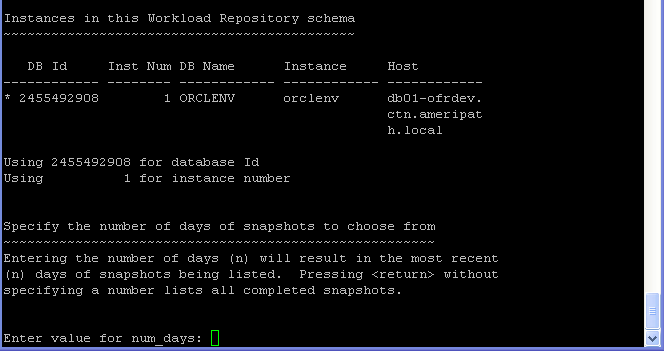
Step 6: Select number of days you want to go back or just hit enter for listing all
completed snapshots, if you press ENTER it will give you all snapshot .

Step 7: Then specify Begin and End snapshot Ids.

Step 8: Here you specify the name of the report or select the default name assigned.

Exit Sql , And Search for your report_name in the Same Directory .

 Just As Note :

@?/rdbms/admin/awrrpti.sql – Script can be used for the specified database and instance so the script in addition will prompt for dbid and instance number.

@?/rdbms/admin/awrddrpt.sql – Script can be used to generate a combine report of 2 different snapshots for comparison of performance in one report so it will prompt for two pairs of snapshot snapshots to compare against.


@?/rdbms/admin/awrinfo.sql – Script print AWR information like space usage by AWR, subset of AWR snap ids, Automatic Database Diagnostic Monitor (ADDM), Active Session History (ASH) information.


@?/rdbms/admin/awrrpt.sql – It is an interactive script that can be used to generate HTML or text reports. The script prompts for type of report requested and prompts for number of days of snapshots to choose from so based on that it displays snap ids to choose the start and end snapshot it.

The Next Post will be How to read AWR Tips .

 
 Enjoy

Osama Mustafa

SYS_CONTEXT

Oracle has a very useful built-in function called SYS_CONTEXT. The syntax of this function goes like this:

SYS_CONTEXT ( 'namespace' , 'parameter' [, length] )

SYS_CONTEXT returns the value of parameter associated with the context namespace. You can use this function in both SQL and PL/SQL statements.

What makes this function more interesting is the fact that Oracle provides a built-in namespace called USERENV with predefined parameters, which describes the current session. Go ahead and run the following query:

select 
sys_context('USERENV','AUTHENTICATION_TYPE')
,sys_context('USERENV','CURRENT_SCHEMA')
,sys_context('USERENV','CURRENT_SCHEMAID')
,sys_context('USERENV','CURRENT_USER')
,sys_context('USERENV','CURRENT_USERID')
,sys_context('USERENV','DB_DOMAIN')
,sys_context('USERENV','DB_NAME')
,sys_context('USERENV','HOST')
,sys_context('USERENV','INSTANCE')
,sys_context('USERENV','IP_ADDRESS')
,sys_context('USERENV','ISDBA')
,sys_context('USERENV','LANG')
,sys_context('USERENV','LANGUAGE')
,sys_context('USERENV','NETWORK_PROTOCOL')
,sys_context('USERENV','NLS_CALENDAR')
,sys_context('USERENV','NLS_CURRENCY')
,sys_context('USERENV','NLS_DATE_FORMAT')
,sys_context('USERENV','NLS_DATE_LANGUAGE')
,sys_context('USERENV','NLS_TERRITORY')
,sys_context('USERENV','OS_USER')
,sys_context('USERENV','SESSION_USER')
,sys_context('USERENV','SESSION_USERID')
,sys_context('USERENV','SESSIONID')
,sys_context('USERENV','TERMINAL')
from dual

Amazing , you can Use this Function in Oracle Security .

Enjoy

Thank you
Osama mustafa
 

Migrate the database From File System to ASM

I posted before Migration Database from ASM to File System,But today i will talk about How to migration File System to ASM and this is the common case I hope i will describe this topics so well,Please if you have any In-query Contact me,Comment i will answer you,Helping you is my pleasure:


Steps:

1.configure flash recovery area.
2.Migrate datafiles to ASM.
3.Control file to ASM.
4.Create Temporary tablespace.
5.Migrate Redo logfiles
6.Migrate spfile to ASM.


step 1:Configure flash recovery area.

SQL> connect sys/sys@orcl as sysdba
Connected.
 
SQL> alter database disable block change tracking;

Database altered.

SQL> alter system set db_recovery_file_dest_size=500m;

System altered.

SQL> alter system set db_recovery_file_dest=’+FRAG’;

System altered

step 2 and 3: Migrate data files and control file to ASM

Use RMAN to migrate the data files to ASM disk groups,All data files will be migrated to the newly
 created disk group, DATA
 
SQL> alter system set db_create_file_dest='+DATA';

System altered.

SQL> alter system set control_files='+DATA/control_new.ctl' scope=spfile;

System altered.

SQL> shutdown immediate

[oracle@rac1 bin]$ ./rman target /


RMAN> startup nomount
RMAN> restore controlfile from '/u01/new/oracle/oradata/mydb/control01.ctl';
RMAN> alter database mount;
RMAN> backup as copy database format '+DATA';
RMAN> switch database to copy;
RMAN> alter database open;

RMAN>Exit ;

SQL> conn sys/oracle as sysdba

Connected.

SQL> select tablespace_name,file_name from dba_data_files;

TABLESPACE_NAME FILE_NAME

------------------------------ ---------------------------------------------

USERS +DATA/mydb/datafile/users.261.705064915

UNDOTBS1 +DATA/mydb/datafile/undotbs1.259.705064821

SYSAUX +DATA/mydb/datafile/sysaux.258.705064283

SYSTEM +DATA/mydb/datafile/system.257.705063763


SQL> select name from v$controlfile;


NAME
----

+DATA/control_new.ctl


step 4:Migrate temp tablespace to ASM.
 
SQL> alter tablespace temp add tempfile size 100m;

Tablespace altered.

SQL> select file_name from dba_temp_files;
FILE_NAME

---------------------------------------------

+DATA/mydb/tempfile/temp.263.705065455

otherwise,Create temporary tablespace in ASM disk group.

SQL> CREATE TABLESPACE temp1 TEMPFILE ‘+diskgroup1’;

SQL> alter database default temporary tablespace temp1;

Database altered.


step 5:Migrate redo logs to ASM.
 
SQL> select member,group# from v$logfile;

you will find i above query the redo-log in file system start adding new one to ASM after this you can delete .

SQL> alter database add logfile group 5 size 5m;

Database altered.

SQL> alter database add logfile group 6 size 5m;

Database altered.

For example to drop , you can do the following :

SQL> alter system switch logfile;

System altered.

SQL> alter database drop logfile group 2;

Database altered.

SQL> alter database drop logfile group 3;

Database altered.

SQL> alter database drop logfile group 4;

Database altered.

SQL> alter database drop logfile group 1;

Database altered.

Now we can say we finish But we have to do Two More Steps 


Add additional control file


SQL> connect sys/sys@ORCL as sysdba
Connected to an idle instance.
SQL> startup mount
ORACLE instance started.

SQL> alter database backup controlfile to '+DATA/Control_new02.ctl';

Database altered.

SQL> alter system set control_files='+DATA/
Control_new.ctl '
,'+DATA/
Control_new02.ctl' scope=spfile;

System altered.

SQL> shutdown immediate;
ORA-01109: database not open

Database dismounted.
ORACLE instance shut down.
SQL> startup
ORACLE instance started.


Step 6:Migrate spfile to ASM:

Create a copy of the SPFILE in the ASM disk group.
 
If the database is using an SPFILE already, then run these commands:

run {
BACKUP AS BACKUPSET SPFILE;
RESTORE SPFILE TO "+DISK/spfile";

But if you are not using One :

SQL> create spfile='+DISK/spfile' from pfile='$ORACLE_HOME/dbs/initORCL.ora';


 Thank you
Osama mustafa


Duplicate Database Using RMAN / Clone Database

Step By Step : Cloning Database On the Same Server / Using Rman Duplicate From Active Database

The Below Link Contain Document Describe Step by Step how to Duplicate Database Using RMAN ,

Cloning Database / Duplicate Database Using RMAN

Enjoy

Thank you
Osama mustafa

Set Listener Password

In Oracle 10g and above, the listener is secured by default, and only user who started the listener can run the commands.

In order to set password on listener, follow the steps:

1) LSNRCTL> set current_listener
2) LSNRCTL> change_password
Old password:
New password: yourpassword
Reenter new password: yourpassword
3) LSNRCTL> save_config
4) LSNRCTL> status

Now Any One Want Start Administrating Listener Will be Asked for Password , After This you can manager Your Listener .

As the another user, enter the password to administer the listener:

1) LSNRCTL> set password
Password: yourpassword
2) LSNRCTL> stop

Thank you
Osama mustafa

Step By Step To Migration ASM to File System

There’s More than One Way For this Migration you can use what you want

Lets Get The Database Data Files :


1-See your Database Files :

SQL>select file_name from dba_data_files;

 +DATA/test/datafile/undotbs1.301.697649965
+DATA/test/datafile/sysaux.300.697649963
+DATA/test/datafile/system.299.697649963
+DATA/test/datafile/users.302.697649965
+DATA/test/datafile/users.309.697650601

select tablespace_name,count(file_name) from dba_data_files group by tablespace_name ORDER BY 2

Use the above query to see how many data files under tablespace .

Now After see the DataFile , we need to create new Directory to copy the data file to it .
  mkdir /app/oracle/TEST


2- We Will Create Our Own Script And Copy our Database File to our new location :

sqlplus / as sysdba

set lines 120 pages 0

select ‘copy datafile ‘||file_id||’ to ‘||”’/app/oracle/TEST/’||substr(file_name,21,instr(file_name,’.’)-21)||’_01.dbf”’||’;’ from dba_data_files order by 1;

copy datafile 1 to ‘/app/oracle/TEST/system_01.dbf’;

copy datafile 2 to ‘/app/oracle/TEST/sysaux_01.dbf’;

copy datafile 3 to ‘/app/oracle/TEST/undotbs1_01.dbf’;

copy datafile 4 to ‘/app/oracle/TEST/users_01.dbf’;

copy datafile 5 to ‘/app/oracle/TEST/users_02.dbf’;

shutdown immediate;

startup mount;

exit

rman target /

copy datafile 1 to ‘/app/oracle/TEST/system_01.dbf’;

copy datafile 2 to ‘/app/oracle/TEST/sysaux_01.dbf’;

copy datafile 3 to ‘/app/oracle/TEST/undotbs1_01.dbf’;

copy datafile 4 to ‘/app/oracle/TEST/users_01.dbf’;

copy datafile 5 to ‘/app/oracle/TEST/users_02.dbf’;

exit

sql / as sysdba

select ‘alter database rename file ”’||file_name||”’ to ‘||”’/app/oracle/TEST/’||substr(file_name,21,instr(file_name,’.’)-21)||’_01.dbf”’||’;’ from dba_data_files order by 1;

alter database rename file ‘+DATA/test/datafile/sysaux.300.697649963’ to ‘/app/oracle/TEST/sysaux_01.dbf’;

alter database rename file ‘+DATA/test/datafile/system.299.697649963’ to ‘/app/oracle/TEST/system_01.dbf’;
alter database rename file ‘+DATA/test/datafile/undotbs1.301.697649965’ to ‘/app/oracle/TEST/undotbs1_01.dbf’;
alter database rename file ‘+DATA/test/datafile/users.302.697649965’ to ‘/app/oracle/TEST/users_01.dbf’;

alter database rename file ‘+DATA/test/datafile/users.309.697650601’ to ‘/app/oracle/TEST/users_02.dbf’;

 
 3- This not the finish , there’s some file still On A, Check it by :

open database

select name from v$controlfile
union
select name from v$tempfile
union
select member from v$logfile
union
select filename from v$block_change_tracking;

NAME
——————————————————————————–
+DATA/test/controlfile/current.303.697650047
+DATA/test/onlinelog/group_1.304.697650049
+DATA/test/onlinelog/group_2.305.697650049
+DATA/test/onlinelog/group_3.306.697650049
+DATA/test/tempfile/temp.307.697650095
+FRA/test/controlfile/current.260.697650047
+FRA/test/onlinelog/group_1.261.697650049
+FRA/test/onlinelog/group_2.262.697650049
+FRA/test/onlinelog/group_3.263.697650051

alter database rename file ‘+DATA/test/datafile/sysaux.300.697649963’ to ‘/app/oracle/TEST/sysaux_01.dbf’;

alter database rename file ‘+DATA/test/datafile/system.299.697649963’ to ‘/app/oracle/TEST/system_01.dbf’;

alter database rename file ‘+DATA/test/datafile/undotbs1.301.697649965’ to ‘/app/oracle/TEST/undotbs1_01.dbf’;

alter database rename file ‘+DATA/test/datafile/users.302.697649965’ to ‘/app/oracle/TEST/users_01.dbf’;

alter database rename file ‘+DATA/test/datafile/users.309.697650601’ to ‘/app/oracle/TEST/users_02.dbf’;

ALTER DATABASE ADD LOGFILE GROUP 4 (‘/app/oracle/TEST/redo_04a.dbf’,’/app/oracle/TEST/redo_04b.dbf’) size 50M;

ALTER DATABASE ADD LOGFILE GROUP 5 (‘/app/oracle/TEST/redo_05a.dbf’,’/app/oracle/TEST/redo_05b.dbf’) size 50M;

ALTER DATABASE ADD LOGFILE GROUP 6 (‘/app/oracle/TEST/redo_06a.dbf’,’/app/oracle/TEST/redo_06b.dbf’) size 50M; 

4-the Last Step for Control file and Spfile :


SQL>show parameter control
control_files 
————————–
+DATA/test/controlfile/current .303.697650047
SQL > Create Pfile=” from spfile ;

After Creating Pfile , Open it modify Control File Location to Our New Location /app/oracle/TEST/…

*.control_files=’/app/oracle/TEST/control01.ctl’,’/app/oracle/TEST/control02.ctl’

startup nomount

$rman target /

 restore controlfile from ‘+DATA/test/controlfile/current.303.697650047’;

 exit

create spfile=’/app/oracle/product/11.1.0/db_1/dbs/spfileTEST.ora’ from pfile=’/home/oracle/john.ora’;

File created.

shutdown immediate;
startup

show parameter control

control_files  /app/oracle/TEST/control01.ctl , /app/oracle/TEST/control02.ctl

This Steps Without Using RMAN , I will Post Another Steps Using RMAN

Thank you
Osama mustafa