
To Solve this error Follow the below Steps :
- Edit /owb/bin/admin/Preference.properties
- And set the following parameter :-
- OverrideRepositoryVersionCheck=true
- OverrideRuntimeVersionCheck=true
Thank you
Osama Mustafa
Osama Mustafa
For the people who think differently Welcome aboard
To Solve this error Follow the below Steps :
In old Version Oracle EDQ was no available on Linux Only Windows Operating system as Setup File, But there’s always solution if you want it on Linux you need to use application server in our case weblogic to deploy EDQ on it , some pre requisites need to be done before you do this Please check http://support.oracle.com Document
How To Install EDQ On Linux Using Oracle DB And Apache Tomcat (Doc ID 1462376.1)
Download Document Here
Thank you
Osama mustafa
As Usual I upload it to my slide share account here
Thank you
Osama mustafa




oracle.as.management.opmn.optic.OpticBadConnectException: Failed to create secure socket for OPMN
Change Directory to the to BI instance/Bin Folder and :
[oracle@exalytic bin]$ ./opmnctl stopall
opmnctl stopall: opmn is not running.
[oracle@exalytic bin]$ ./opmnctl startall
opmnctl startall: starting opmn and all managed processes…
[oracle@exalytic bin]$ ./opmnctl status
Processes in Instance: obiee1
———————————+——————–+———+———
ias-component | process-type | pid | status
———————————+——————–+———+———
coreapplication_obiccs1 | OracleBIClusterCo~ | 19837 | Alive
coreapplication_obisch1 | OracleBIScheduler~ | 0 | NONE
coreapplication_obijh1 | OracleBIJavaHostC~ | 19836 | Alive
coreapplication_obips1 | OracleBIPresentat~ | 19840 | Alive
coreapplication_obis1 | OracleBIServerCom~ | 19838 | Alive
Thank you
Osama Mustafa
NAME TYPE VALUE
———————————— ———– ——-
archive_lag_target integer 0
db_flashback_retention_target integer 1440
fast_start_io_target integer 0
fast_start_mttr_target integer 0
memory_max_target big integer 26048M
memory_target big integer 0
parallel_servers_target integer 2048
pga_aggregate_target big integer 6502M
sga_target big integer 19520M
SQL> ALTER SYSTEM SET MEMORY_MAX_TARGET = 16384M scope=spfile ;
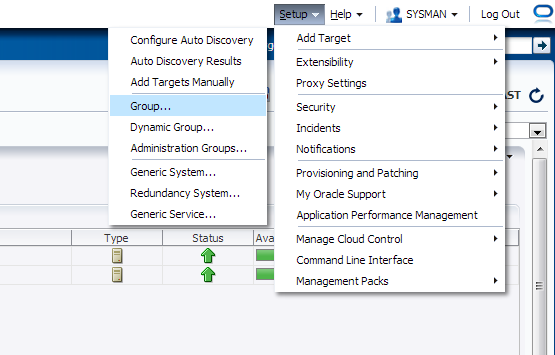
Enterprise manager provide you with Group Features to combine components, and there’s two type :
Check the below screenshot :
From Setup –> Add Target –> Group


Cubes in a data warehouse are stored in three different modes. A relational storage model is called Relational Online Analytical Processing mode or ROLAP, while a Multidimensional Online Analytical processing mode is called MOLAP. When dimensions are stored in a combination of the two modes then it is known as Hybrid Online Analytical Processing mode or HOLAP.
MOLAP
This is the traditional mode in OLAP analysis. In MOLAP data is stored in form of multidimensional cubes and not in relational databases. The advantages of this mode is that it provides excellent query performance and the cubes are built for fast data retrieval. All calculations are pre-generated when the cube is created and can be easily applied while querying data. The disadvantages of this model are that it can handle only a limited amount of data. Since all calculations have been pre-built when the cube was created, the cube cannot be derived from a large volume of data. This deficiency can be bypassed by including only summary level calculations while constructing the cube. This model also requires huge additional investment as cube technology is proprietary and the knowledge base may not exist in the organization.
ROLAP
The underlying data in this model is stored in relational databases. Since the data is stored in relational databases this model gives the appearance of traditional OLAPs slicing and dicing functionality. The advantages of this model is it can handle a large amount of data and can leverage all the functionalities of the relational database. The disadvantages are that the performance is slow and each ROLAP report is an SQL query with all the limitations of the genre. It is also limited by SQL functionalities. ROLAP vendors have tried to mitigate this problem by building into the tool out-of-the-box complex functions as well as providing the users with an ability to define their own functions.
HOLAP
HOLAP technology tries to combine the strengths of the above two models. For summary type information HOLAP leverages cube technology and for drilling down into details it uses the ROLAP model.
Comparing the use of MOLAP, HOLAP and ROLAP
The type of storage medium impacts on cube processing time, cube storage and cube browsing speed. Some of the factors that affect MOLAP storage are:
Cube browsing is the fastest when using MOLAP. This is so even in cases where no aggregations have been done. The data is stored in a compressed multidimensional format and can be accessed quickly than in the relational database. Browsing is very slow in ROLAP about the same in HOLAP. Processing time is slower in ROLAP, especially at higher levels of aggregation.
MOLAP storage takes up more space than HOLAP as data is copied and at very low levels of aggregation it takes up more room than ROLAP. ROLAP takes almost no storage space as data is not duplicated. However ROALP aggregations take up more space than MOLAP or HOLAP aggregations.
All data is stored in the cube in MOLAP and data can be viewed even when the original data source is not available. In ROLAP data cannot be viewed unless connected to the data source.
MOLAP can handle very limited data only as all data is stored in the cube.
Thank you
Osama Mustafa
The unpack command Creates a full domain or a subset of a domain used for a Managed Server domain directory on a remote machine. You may use unpack only with a template compatible with your current installation. The template can be any of the following:
./unpack.sh -domain=/u01/app/oracle/domains/IDMDomains -template=/u01/shared/IDMdomains.jar
ERROR !!! ./unpack.sh -name=Value Missing
The Solution is simple :
-template attribute should come first.
./unpack.sh -template=/u01/shared/IDMdomains.jar -domain=/u01/app/oracle/domains/IDMDomains
Thank you
Osama Mustafa
After Install Weblogic and BI On Windows, And Create Admin Server as Services BI_server unable to start, Node manager Created Service Created Without Any Error.
Cause & Solution :
After Investigation I found Class Path is too Long So what i did like the following, Edit installSVC.cmd To set Classpath to be Short
you will find the below line in the InstallSvc.cmd all you have to do is change it to be like Line in Red Color :
@echo off
echo %CLASSPATH% > %USERDOMAIN_HOME%\cp.properties
if “%ADMIN_URL%” == “” goto runAdmin
@echo on
set CMDLINE=”%JAVA_VM% %MEM_ARGS% %JAVA_OPTIONS%
-classpath @%USERDOMAIN_HOME%\cp.properties
-Dweblogic.Name=%SERVER_NAME% -Dweblogic.management.username=%WLS_USER%
-Dweblogic.management.server=\”%ADMIN_URL%\”
-Dweblogic.ProductionModeEnabled=%PRODUCTION_MODE%
-Djava.security.policy=\”%WL_HOME%\server\lib\weblogic.policy\” weblogic.Server”
goto finish
Thank you
Osama Mustafa
 Technology Geek