Oracle database Version 12.1.0.2

Oracle database Version 12.1.0.2 released today .. available to download.. The important new feature in this release is the Oracle Database In-Memory other new features…
Oracle Database In-Memory
Oracle Big Data SQL
Advanced Index Compression
Zone Maps
Approximate Count Distinct
Attribute Clustering
Full Database Caching
Rapid Home Provisioning

Download Here

Thank you
Osama Mustafa

[Security:090482]BAD_CERTIFICATE alert was received from Hostname

[Security:090482]BAD_CERTIFICATE alert was received from Hostname. Check the peer to determine why it rejected the certificate chain (trusted CA configuration, hostname verification). SSL debug tracing may be required to determine the exact reason the certificate was rejected.>
javax.net.ssl.SSLKeyException: [Security:090482]BAD_CERTIFICATE alert was received from Hostname. Check the peer to determine why it rejected the certificate chain (trusted CA configuration, hostname verification). SSL debug tracing may be required to determine the exact reason the certificate was rejected.
at com.certicom.tls.interfaceimpl.TLSConnectionImpl.fireException(Unknown Source)
at com.certicom.tls.interfaceimpl.TLSConnectionImpl.fireAlertReceived(Unknown Source)
at com.certicom.tls.record.alert.AlertHandler.handle(Unknown Source)
at com.certicom.tls.record.alert.AlertHandler.handleAlertMessages(Unknown Source)
at com.certicom.tls.record.MessageInterpreter.interpretContent(Unknown Source)
at com.certicom.tls.record.MessageInterpreter.decryptMessage(Unknown Source)
at com.certicom.tls.record.ReadHandler.processRecord(Unknown Source)
at com.certicom.tls.record.ReadHandler.readRecord(Unknown Source)
at com.certicom.tls.record.ReadHandler.readUntilHandshakeComplete(Unknown Source)
at com.certicom.tls.interfaceimpl.TLSConnectionImpl.completeHandshake(Unknown Source)
at com.certicom.tls.record.ReadHandler.read(Unknown Source)
at com.certicom.io.InputSSLIOStreamWrapper.read(Unknown Source)
at sun.nio.cs.StreamDecoder.readBytes(StreamDecoder.java:264)
at sun.nio.cs.StreamDecoder.implRead(StreamDecoder.java:306)
at sun.nio.cs.StreamDecoder.read(StreamDecoder.java:158)
at java.io.InputStreamReader.read(InputStreamReader.java:167)
at java.io.BufferedReader.fill(BufferedReader.java:136)
at java.io.BufferedReader.readLine(BufferedReader.java:299)
at java.io.BufferedReader.readLine(BufferedReader.java:362)
at weblogic.nodemanager.server.Handler.run(Handler.java:71)
at java.lang.Thread.run(Thread.java:662)

You need to recreate the certification again :-
Depend on your Operating system :-

$WL_HOME/server/bin/setWLSEnv.sh Or setWLSEnv.cmd

cd $WL_HOME/server/lib

 Copy DemoIdentity.jks to another directory as backup.

then inside the WLS_HOME/server/lib run:-

Generate the private key.

java utils.CertGen -keyfilepass DemoIdentityPassPhrase -certfile newcert -keyfile newkey 

Import the key generated

java utils.ImportPrivateKey -keystore DemoIdentity.jks -storepass DemoIdentityKeyStorePassPhrase -keyfile newkey.pem -keyfilepass DemoIdentityPassPhrase -certfile newcert.pem -alias demoidentity 

 Restart AdminConsole and Nodemanager and try to start managed server.

Thank you
Osama mustafa

Oracle Application Adapter installation.

Regarding to Oracle Documentation :-

The Application Adapter installer for 11g Release 1 (11.1.1.3.0) is applicable for the Oracle Service-Oriented Architecture (SOA) Suite and Oracle Service Bus (OSB). The Application Adapters that are installed can be used with Business Process Execution Language (BPEL), Mediator, Business Process Management (BPM), and OSB components. Using this installer, Application Adapters can be installed in a standalone SOA environment, standalone OSB environment, or mixed (SOA and OSB) environment.

You can check from here

The installation is not that hard , it’s all about configuration. i will post about later.

You Can Download it from here.

Operating system : Oracle Linux.

Installation Steps :-

As You see you should installed Oracle SOA Or Oracle OSB.
If you are using Oracle SOA the path will be like the below :-
\Oracle_SOA1\
For Oracle OSB :-
\Oracle_OSB1\
Be Notice this application installed in the following Path :-
\Oracle_SOA1\soa\thirdparty\ApplicationAdapters\
Thank you 
Osama mustafa

Extend LVM Disk Linux

This Article Will Describe step by step how to extend LVM Disk On Linux :-

1- After adding New Harddisk to the server you have to ReScan The Scsi using 

echo “- – -” > /sys/class/scsi_host/host?/scan

? :- Depend on you host number. 

2-  Use Fdisk to create new partition.

>fdisk -l
Disk /dev/sda: 107.3 GB, 107374182400 bytes
255 heads, 63 sectors/track, 13054 cylinders
Units = cylinders of 16065 * 512 = 8225280 bytes
   Device Boot      Start         End      Blocks   Id  System
/dev/sda1   *           1          13      104391   83  Linux
/dev/sda2              14       13054   104751832+  8e  Linux LVM
Disk /dev/sdb: 10.7 GB, 10737418240 bytes
255 heads, 63 sectors/track, 1305 cylinders
Units = cylinders of 16065 * 512 = 8225280 bytes

Disk /dev/sdb doesn’t contain a valid partition table

 Check the below :-

#fdisk /dev/sdb
Device contains neither a valid DOS partition table, nor Sun, SGI or OSF disklab el
Building a new DOS disklabel. Changes will remain in memory only,
until you decide to write them. After that, of course, the previous
content won’t be recoverable.

The number of cylinders for this disk is set to 1305.
There is nothing wrong with that, but this is larger than 1024,
and could in certain setups cause problems with:
1) software that runs at boot time (e.g., old versions of LILO)
2) booting and partitioning software from other OSs
(e.g., DOS FDISK, OS/2 FDISK)
Warning: invalid flag 0x0000 of partition table 4 will be corrected by w(rite)

Command (m for help): n
Command action
e extended
p primary partition (1-4)
p
Partition number (1-4): 1
First cylinder (1-1305, default 1):
Using default value 1
Last cylinder or +size or +sizeM or +sizeK (1-1305, default 1305):
Using default value 1305

Command (m for help): w
The partition table has been altered!

Calling ioctl() to re-read partition table.

WARNING: Re-reading the partition table failed with error 16: Device or resource busy.
The kernel still uses the old table.
The new table will be used at the next reboot.
Syncing disks.

3-  Lets start increasing :-

pvcreate /dev/sdb1
Writing physical volume data to disk “/dev/sdb1”
Physical volume “/dev/sdb1” successfully created

vgdisplay
— Volume group —
VG Name Oracle
System ID
Format lvm2
Metadata Areas 1
Metadata Sequence No 4
VG Access read/write
VG Status resizable
MAX LV 0
Cur LV 3
Open LV 3
Max PV 0
Cur PV 1
Act PV 1
VG Size 99.88 GB
PE Size 32.00 MB
Total PE 3196
Alloc PE / Size 3196 / 99.88 GB
Free PE / Size 0 / 0
VG UUID MZ04D3-jZLy-0BWi-2WSP-oi9E-hBkl-e3a08d

vgextend Oracle /dev/sdb1  Volume group “Oracle” successfully extended

 pvscan
  PV /dev/sda2   VG Oracle   lvm2 [99.88 GB / 0    free]
  PV /dev/sdb1   VG Oracle   lvm2 [9.97 GB / 9.97 GB free]
  Total: 2 [109.84 GB] / in use: 2 [109.84 GB] / in no VG: 0 [0   ]

###

lvdisplay
— Logical volume —
LV Name /dev/Oracle/LogVol00
VG Name Oracle
LV UUID wKMZ16-LHsc-ktsc-3dTT-ieiq-pEfT-tODhqc
LV Write Access read/write
LV Status available
# open 1
LV Size 9.75 GB
Current LE 312
Segments 1
Allocation inherit
Read ahead sectors auto
– currently set to 256
Block device 253:0

— Logical volume —
LV Name /dev/Oracle/LogVol02
VG Name Oracle
LV UUID UabZCO-G8ID-dh1a-xv6t-Ss4O-QqEx-fnIy5g
LV Write Access read/write
LV Status available
# open 1
LV Size 82.34 GB
Current LE 2635
Segments 1
Allocation inherit
Read ahead sectors auto
– currently set to 256
Block device 253:1

— Logical volume —
LV Name /dev/Oracle/LogVol01
VG Name Oracle
LV UUID 78Y3bv-UZZI-Iu2w-gAyD-HXe1-Fx25-gmGuKn
LV Write Access read/write
LV Status available
# open 1
LV Size 7.78 GB
Current LE 249
Segments 1
Allocation inherit
Read ahead sectors auto
– currently set to 256
Block device 253:2

Now Let’s Extend :-

lvextend /dev/Oracle/LogVol00 /dev/sdb1 Extending logical volume LogVol00 to 19.72 GB
Logical volume LogVol00 successfully resized

 Finally :-

resize2fs /dev/Oracle/LogVol00resize2fs 1.39 (29-May-2006)
Filesystem at /dev/Oracle/LogVol00 is mounted on /; on-line resizing required
Performing an on-line resize of /dev/Oracle/LogVol00 to 5169152 (4k) blocks.

Notes :

  1. The Red Color for Command Line.
  2. The Brown Color For necessary Output. 
  3. /dev/Oracle/LogVol00 it’s the name for LVM Disk.
  4. /dev/sdb1 disk that we created using fdisk.

Thank you
Osama Mustafa

java.lang.ClassNotFoundException: oracle.dms.wls.DMSServletFilter

This Error Appeared while trying to start managed Server “edq_server1” , The starting results it’s completed with successfully status but some deployment end with Failed status , which mean edq_server will not work correctly, therefore i checked the logs which the below error :-

Caused By: java.lang.ClassNotFoundException: oracle.dms.wls.DMSServletFilter
        at weblogic.utils.classloaders.GenericClassLoader.findLocalClass(GenericClassLoader.java:297)
        at weblogic.utils.classloaders.GenericClassLoader.findClass(GenericClassLoader.java:270)
        at weblogic.utils.classloaders.ChangeAwareClassLoader.findClass(ChangeAwareClassLoader.java:64)
        at java.lang.ClassLoader.loadClass(ClassLoader.java:424)
        at java.lang.ClassLoader.loadClass(ClassLoader.java:357)
        at weblogic.utils.classloaders.GenericClassLoader.loadClass(GenericClassLoader.java:179)
        at weblogic.utils.classloaders.ChangeAwareClassLoader.loadClass(ChangeAwareClassLoader.java:43)
        at weblogic.servlet.internal.WebComponentContributor.getNewInstance(WebComponentContributor.java:224)

To solve this error :-

cd /u01/app/oracle/product/fmw/wlserver_10.3/common/nodemanager
vi nodemanager.properties

And search for 

StartScriptEnabled=false

change it to

StartScriptEnabled=true

Restart Node manager and try again.
Thank you
Osama Mustafa

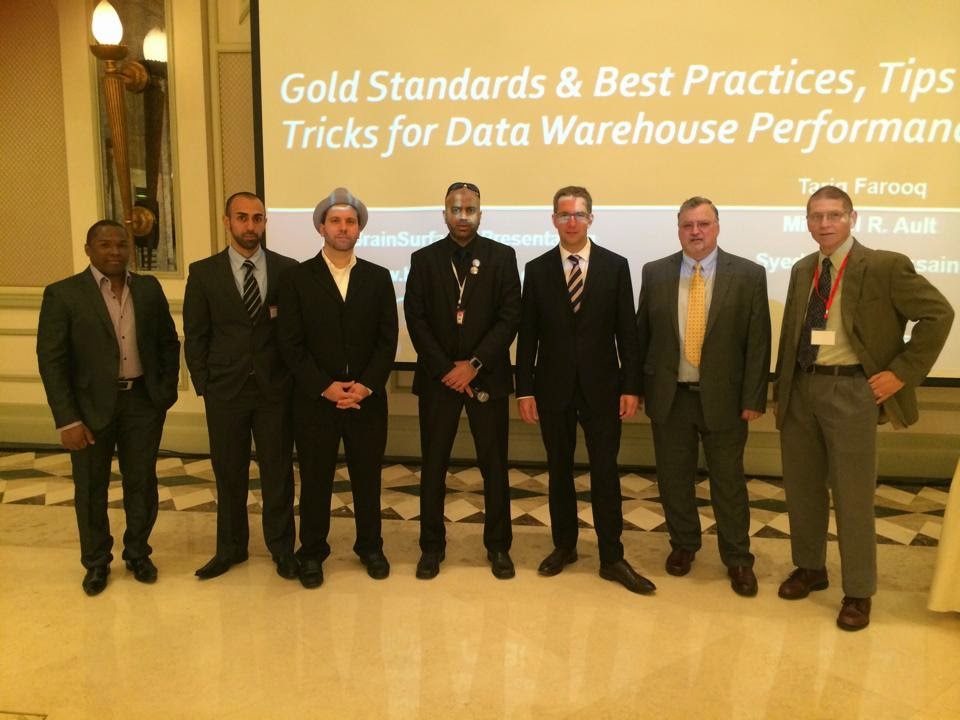
OTN MENA Tour Experience – Dubai

Don’t be dismayed by good-byes. A farewell is necessary before you can meet again. And meeting again, after moments or lifetimes, is certain for those who are friends.


I Thought it will be nice to share this quotation before start talking about Oracle OTN Tour – MENA TOUR 2014. 
Fir the people who dosen’t know anything about this Tour it’s happened for the first time in middle-east, 
“Courtesy of the Oracle Technology Network (OTN) and the ARABOUG, the inaugural 2014 OTN MENA Tour brings a star-studded cast, consisting of some of the world’s best Oracle ACEs, ACE Directors and Rock Star Speakers to the region. The tour aims at sharing cutting edge knowledge and independent research in the MENA region, by accomplished Oracle experts from all over the world”
Covered the following countries :-
  • Tunisia
  • KSA- Saudi Arabia
  • Dubai.
Link Here.
Picture for the speaker getting ready for the event :-
Introduction about the Speaker :-
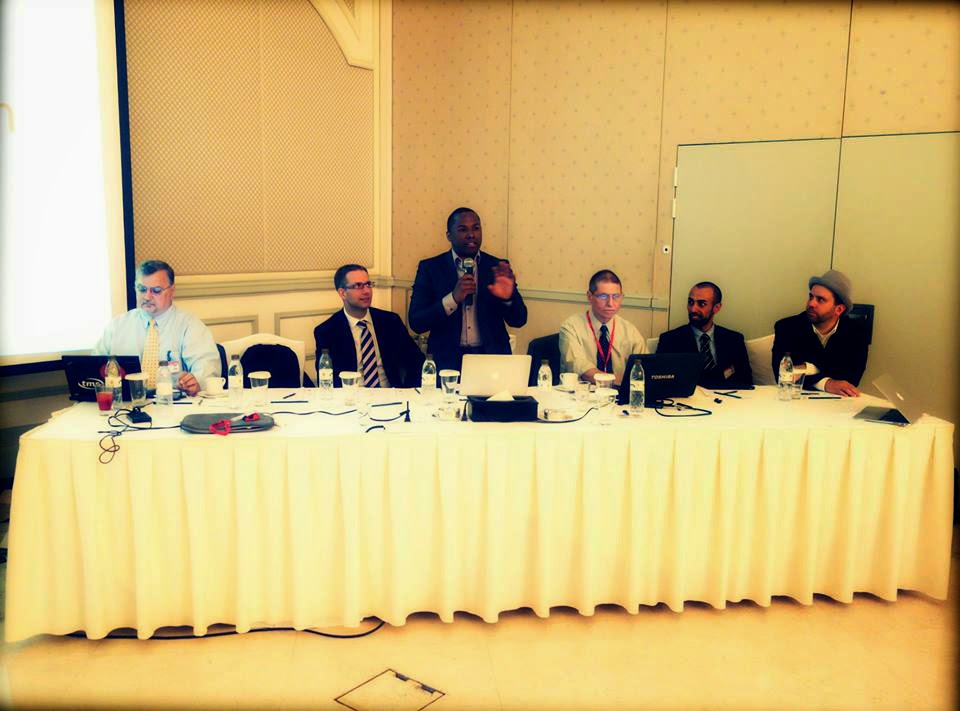
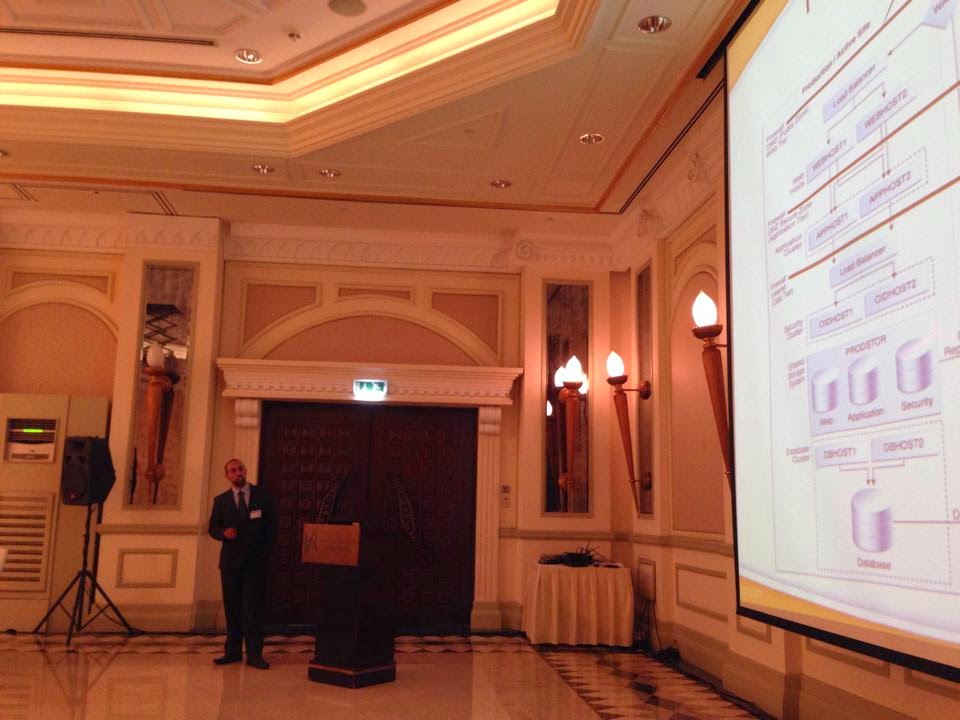
I will talking about Dubai, The event location was In Habtoor Grand Beach Resort & Spa. started at 8 Am – 5 pm During this time Oracle experts start sharing their knowledge and  chatting with them.
Different Topics , Different Speaker But it’s Only About Oracle, Performance tips, I/O , 12c , Fusion middleware , RAC 12c …
I spoke about Oracle Fusion middleware high Availability and crowd was really amazing.


I will do it again for sure Enshalla.

Thank you
Osama mustafa.

Enable Samba to Share from Linux to Windows

To Setup and configure Shared Folder From Linux to Windows Follow the Below Steps :-

  • Install Samba Package on OS using the below command.
    • rpm -ivh samba Or yum install samba
  • After Install The Package configure   Username and password using the below command :-
    • smbpasswd -a oracle ( Or Any other user you want to share folder with )
  • On Linux Side –> Create Directory using mkdir /u01/share.
  • edit vi /etc/samba/smb.conf and configure the file to allow share to the above folder.

[Folder-name]
path = Folder_path
available = yes
valid users = User_will_user_folder.
read only = no
browsable = yes
public = yes
writable = yes

  • Restart Samba Services –> service smb restart
  • On Windows you can access the folder using Run –> \\Linux-Ip and enter the username and password.

Thank you
Osama Mustafa

OTech Magazine 2014

Independent magazine for Oracle technology professionals. OTech Magazine will be published digitally four times a year. Every season. 

The first edition will be published Fall 2013. OTech Magazine articles are written by the Top-100 consultants in the Oracle-field around the globe. Only selected authors can publish in OTech Magazine.

OTech Magazine offers insight in complex Oracle projects and solutions.

My Article Included in this Version of OTech Magazine You Can Check The Magazine Here

 I Want to take this Opportunity to Thanks Douwe Pieter for his great efforts.

Thank you 
Osama Mustafa