MOLAP, ROLAP And HOLAP

I would like to share this article that i found recenly on internet talking about Online Analytic Processing By John Here

Cubes in a data warehouse are stored in three different modes. A relational storage model is called Relational Online Analytical Processing mode or ROLAP, while a Multidimensional Online Analytical processing mode is called MOLAP. When dimensions are stored in a combination of the two modes then it is known as Hybrid Online Analytical Processing mode or HOLAP.

MOLAP 

This is the traditional mode in OLAP analysis. In MOLAP data is stored in form of multidimensional cubes and not in relational databases. The advantages of this mode is that it provides excellent query performance and the cubes are built for fast data retrieval. All calculations are pre-generated when the cube is created and can be easily applied while querying data. The disadvantages of this model are that it can handle only a limited amount of data. Since all calculations have been pre-built when the cube was created, the cube cannot be derived from a large volume of data. This deficiency can be bypassed by including only summary level calculations while constructing the cube. This model also requires huge additional investment as cube technology is proprietary and the knowledge base may not exist in the organization.

ROLAP  

The underlying data in this model is stored in relational databases. Since the data is stored in relational databases this model gives the appearance of traditional OLAPs slicing and dicing functionality. The advantages of this model is it can handle a large amount of data and can leverage all the functionalities of the relational database. The disadvantages are that the performance is slow and each ROLAP report is an SQL query with all the limitations of the genre. It is also limited by SQL functionalities. ROLAP vendors have tried to mitigate this problem by building into the tool out-of-the-box complex functions as well as providing the users with an ability to define their own functions.

HOLAP  

HOLAP technology tries to combine the strengths of the above two models. For summary type information HOLAP leverages cube technology and for drilling down into details it uses the ROLAP model.

Comparing the use of MOLAP, HOLAP and ROLAP

The type of storage medium impacts on cube processing time, cube storage and cube browsing speed. Some of the factors that affect MOLAP storage are:

Cube browsing is the fastest when using MOLAP. This is so even in cases where no aggregations have been done. The data is stored in a compressed multidimensional format and can be accessed quickly than in the relational database. Browsing is very slow in ROLAP about the same in HOLAP. Processing time is slower in ROLAP, especially at higher levels of aggregation.

MOLAP storage takes up more space than HOLAP as data is copied and at very low levels of aggregation it takes up more room than ROLAP. ROLAP takes almost no storage space as data is not duplicated. However ROALP aggregations take up more space than MOLAP or HOLAP aggregations.

All data is stored in the cube in MOLAP and data can be viewed even when the original data source is not available. In ROLAP data cannot be viewed unless connected to the data source.

MOLAP can handle very limited data only as all data is stored in the cube.

Thank you
Osama Mustafa
unpack.sh Error -name=Value

The pack command creates a template archive (.jar) file that contains a snapshot of either an entire domain or a subset of a domain. You can use a template that contains a subset of a domain to create a Managed Server domain directory hierarchy on a remote machine.

The unpack command Creates a full domain or a subset of a domain used for a Managed Server domain directory on a remote machine. You may use unpack only with a template compatible with your current installation. The template can be any of the following:

  •  A domain template provided by BEA and packaged with your current installation
  •  A domain template created using the Domain Template Builder or WLST Offline
  •  A domain template created using the pack command
  •  A Managed Server template created using the pack command. A Managed Server template, by default, contains only the files necessary for creating a Managed Server domain directory.
You Can Check Oracle Documentation here for more information about the above commands.
When Trying to use unpack command with the below command:

./unpack.sh -domain=/u01/app/oracle/domains/IDMDomains -template=/u01/shared/IDMdomains.jar

The below error appear :

ERROR !!! ./unpack.sh -name=Value Missing

The Solution is simple :

-template attribute should come first. 

./unpack.sh  -template=/u01/shared/IDMdomains.jar -domain=/u01/app/oracle/domains/IDMDomains

Thank you
Osama Mustafa

Oracle SOA Installation on Solaris 11.1

Another Post Describe how to install Oracle SOA, Steo by Step To Install Oracle SOA and Extend Admin Server.

As Usual you can download this document From SlideShare.

Download Document Here.

Thank you
Osama Mustafa

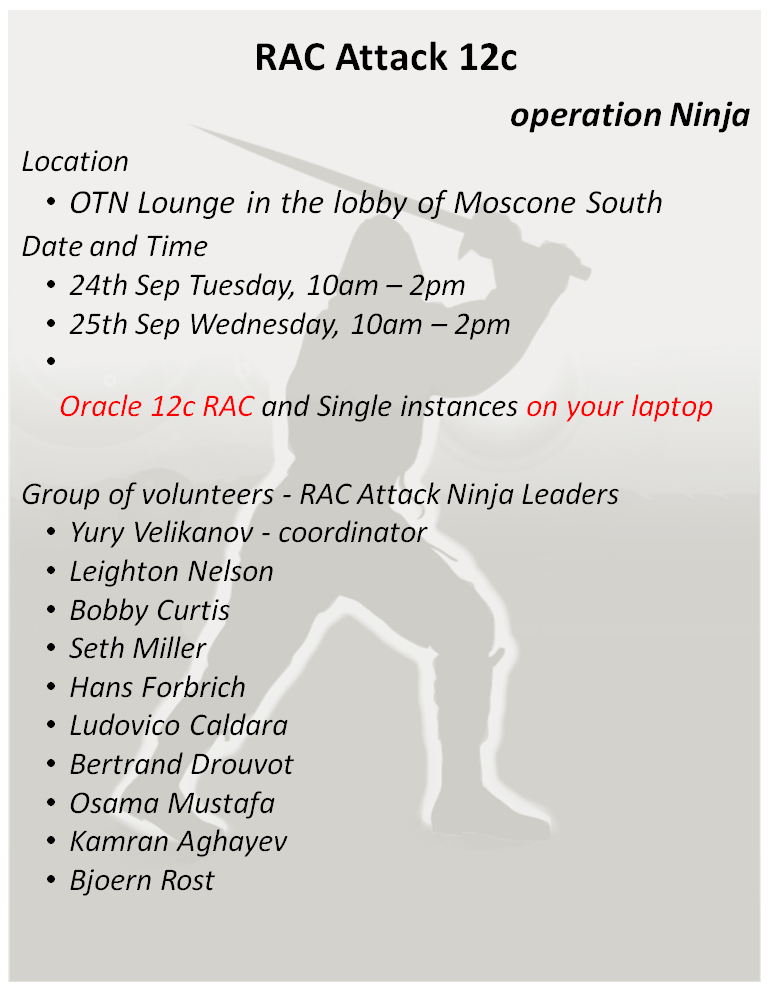
RAC Attack Survey

Count Down is already started, Less than 10 days to Oracle Open World 2013, Sessions, Groups and Discussions/Panel , but this year will be different, as we all know Oracle Database 12c has been released in July some of us got some time to test and work on it. Database and advance Features such as Real Application Cluster (RAC).

Don’t Worry you didn’t mess you chance yet. This Year specifically in Oracle Open World 2013 You will have chance to test Oracle Real Application Cluster on your Own Laptop, Created by yourself, and it will not take that much time, learn the steps and have chance to be DBA.

RACATTACK events Created by Volunteers

you can know more about this event here, Join us and Learn Something New and Meet the Oracle Guru, it will be nice to see everybody there.
Complete this Survey Please Here
Thank you 
Osama Mustafa

Step by Step Configure SSO Using Oracle Fusion Middle-ware

I would like to share this document , which is describe step by step dealing with :

  • WebLogic
  • Oracle Internet Directory
  • Oracle Content Server
  • Oracle Access manager 
Every thing mentioned with Installation &  Configuration Steps.
I tried To make it simple as i can, Included with Screen Shots ,Step By Step how to install The above Oracle Products and how to configure them to prepare your application for Single-Sing-On 
Please if you would like to share this document ask me before.

You can View and Download the Document from Here
Thank you 
Osama mustafa

SIEBEL odbcsql Unable to Connect

Logging into “SBA_81_DSN” as “SADMIN” …
ODBC error 81 in SQLConnect:
523 72
(native error 0).
Unable to login using specified ODBC parameters.

The above error appear when you are trying to run the below command:

odbcsql /s SIEBEL8_DSN /u sadmin /p sadmin

Solutions :

Make sure the you set TNS_ADMIN in .profile or .bash_profile , TNS_ADMIN Should be Directed to Client32 bit , Copy tnsnames.ora from Database home to Client32

it will be like the following :

export TNS_ADMIN=/u01/app/oracle/instanctclient32/

Thank you
Osama mustafa

Mount NFS Device Is Busy

This Error Appear On Solaris when you try to mount filesystem :

mount -F nfs IP:/export/home/oracle/test /export/home/oracle/test

Output :

nfs mount: mount: /export/home/oracle/test : Device busy

Check why it’s Busy using :

fuser -u /export/home/oracle/test

/export/home/oracle/test :     1432c(oracle)

Kill the process :

kill – 9 1432 

Thank you
Osama mustafa